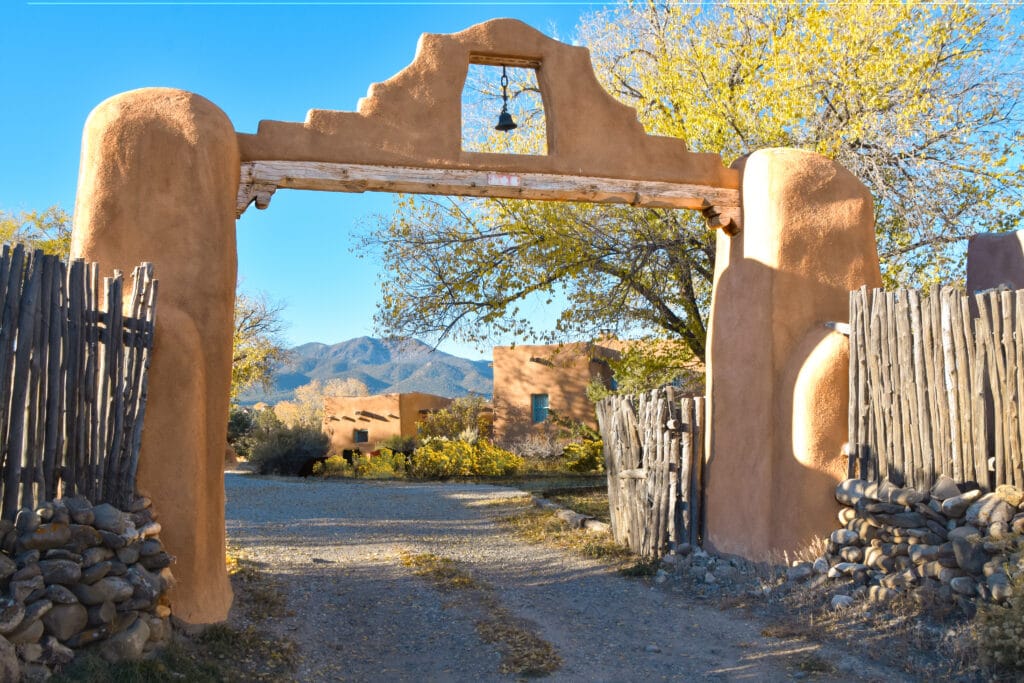
Welcome to the La Cumbre Center for Arts and Culture in Taos. Join us! La Cumbre’s five buildings sit on eight acres of heritage farmland in Talpa, the earliest Hispanic settlement in Taos Valley. La Cumbre and our partner Taos Historic Museums collaborate with Futuros Ancestral uniting traditional shepherds of native flocks in the Four Corners area with authentic sheering, spinning and weaving techniques. Over 70 Taos Pueblo, New Mexico Hispanic, Diné (Navajo), Tlinget (Pacific Northwest) and Anglo teachers and students gather for classes and residencies at La Cumbre to share ancestral, sustainable methods, building friendships and sharing traditions lost to many members as individuals.

Weaving and Earth Ovens
FOR MORE DETAILS, PLEASE VISIT FUTUROS ANCESTRAL

In addition to weaving, Futuros has built numerous Adobe “Earth Ovens,” or traditional wood-fired hornos on Taos Pueblo, at Taos Land Trust, the Talpa Community Center and in conjunction with private homeowners who might otherwise have lost the art of horno construction.
“Sharing space with other artists and especially weavers has been essential to my growth as an artist. I use traditional methods to turn mountain goat hides into yarn — a difficult task. I’ve never processed one so quickly as when telling stories and working together with our Diné relatives during my residency. From laughter to moments of creative silence, we share similarities and differences in technique across the different weaving traditions.”
—Artist-in-Residence Laine Rinehart (Taos Pueblo, Tlingit)
“La Cumbre has been instrumental in bringing weaving and other fiber art traditions together. Of extreme importance is colcha embroidery — a traditional Spanish colonial art form of the Rio Grande Valley. We’ve struggled in the past
to keep the tradition alive. Through workshops and shared space, the studio at La Cumbre is supporting us in bringing colcha to new artists so the art form is not lost again.”
—Award-winning colcha artist and educator, Benita Ortega-Rael (Ranchos de Taos)
“La Cumbre brings together Spanish, Anglo, and Native American artists — including Pueblo, Navajo, and Tlingit cultures. I have rarely seen all three groups collaborating and [until La Cumbre], I haven’t seen a space that connects these artforms. We came together through weaving and now, because of the La Cumbre studio, we are collaborating on new projects in agriculture, adobe construction, and traditional foods.”
—Artist-in-Residence, Marlee Espinosa (Taos Pueblo)
“When coming to Taos from Navajo Nation for my residency, I was hesitant and not sure if I would be welcomed by the Pueblo weavers. But I was surprised that they enjoyed learning from me about how to work with sheep’s wool and I enjoyed helping them with their spinning and weaving projects. And I was inspired by the techniques of the Hispanic weavers. The studio at La Cumbre is helping me build friendships and explore other methods of weaving across tribes and cultures. There are not many places to do that anymore and most people aren’t making things by hand. Together we can keep our legacies alive and show people the true soul of the Southwest.”
— Artist-in-Residence Kevin Tsosie (Diné / Navajo)
The La Cumbre Compound in Talpa New Mexico: The five buildings at La Cumbre, and even before them the location, have been inspiring people for more than 1,000 years. We understand the original pueblo environs stretched from the Pot Creek location down the valley toward La Cumbre, on the outskirts of the original pueblo before the schism which bifurcated the pueblo into the current Tiwa location below Taos Mountain and Picuris pueblo. The La Cumbre compound sits in the middle between the two pueblos of Picuris and Taos. The first adobe home was expanded in 1928 by Ruth and Frank Swaine. It took on a life as an artistic salon and creative enclave, hosting the likes of DH Lawrence, sculptor and
painter Nicholai Fechin, Mable Dodge and Tony Lujan (who babysat and played with Ruth’s and Frank’s children) and actor Dennis Hopper.
A few members of the La Cumbre Futuros Ancestral weaving community and projects:


